Social Media News Trends
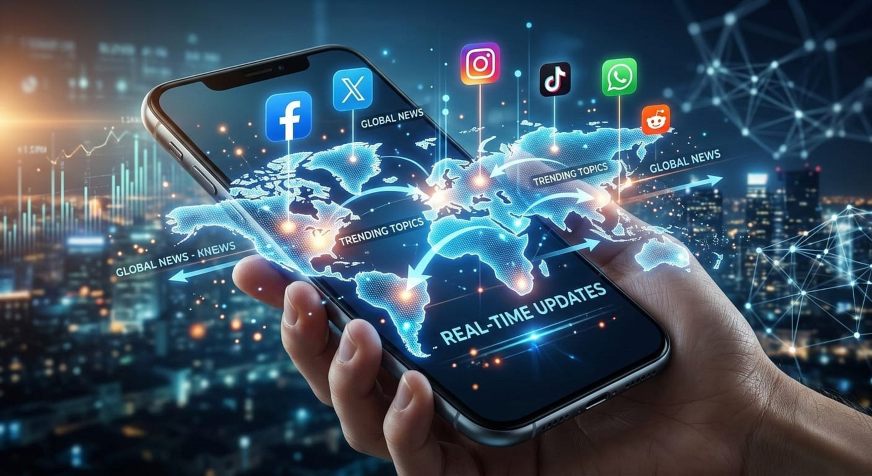
Social media news trends have fundamentally transformed the way information is created, shared, and consumed in the modern world. Platforms like X (formerly Twitter), Facebook, Instagram, TikTok, and YouTube have become primary sources of news for billions of users. This shift has reshaped journalism, making it faster, more interactive, and highly dependent on digital engagement. At the same time, it has introduced new challenges related to credibility, misinformation, and information overload.
Rise of Social Media as a Primary News Source
In the past, people relied mainly on newspapers, television, and radio for news updates. Today, social media platforms have overtaken traditional media as the first point of contact for breaking news. Users often encounter major events on their feeds before they are reported by established news organizations.
This change is driven by speed and accessibility. Social media allows instant sharing of text, images, and videos from anywhere in the world. Eyewitnesses can report events in real time, often providing the first glimpse of unfolding situations such as natural disasters, protests, or political developments.
News organizations have also adapted by maintaining active social media accounts. They publish headlines, live updates, and breaking news alerts directly on these platforms to reach audiences instantly. This has made news consumption more immediate and continuous, rather than scheduled.
Impact of User-Generated Content on Journalism
One of the most significant social media news trends is the rise of user-generated content. Ordinary individuals now play an important role in news reporting by sharing photos, videos, and firsthand accounts of events.
This type of content often serves as the initial source of breaking news. Journalists then verify and build upon this information to create full news stories. In many cases, citizen reports have helped uncover important events that might have otherwise gone unnoticed.
However, user-generated content also presents challenges. Not all information shared on social media is accurate or verified. Videos can be taken out of context, images can be manipulated, and false narratives can spread rapidly.
As a result, journalists must carefully verify content before using it in official reporting. Fact-checking tools, reverse image searches, and metadata analysis are commonly used to confirm authenticity.
Despite these risks, user-generated content has made journalism more inclusive and immediate, allowing more voices to contribute to global news coverage.
Algorithm-Driven News Distribution and Personalization
Social media platforms use algorithms to determine what content users see in their feeds. These algorithms analyze user behavior, interests, and engagement patterns to deliver personalized news content.
This has made news consumption highly customized. Users are more likely to see stories that align with their preferences, location, and online activity. While this improves engagement, it also creates the risk of echo chambers, where individuals are exposed only to viewpoints that match their existing beliefs.
Personalized news feeds have also changed how media organizations distribute content. Headlines, visuals, and engagement strategies are now optimized to perform well within platform algorithms. This has led to a shift in journalism, where attention and engagement metrics play a major role in content visibility.
However, reliance on algorithms raises concerns about transparency and fairness. It can influence public perception by prioritizing certain types of content over others, sometimes without users being fully aware of how their feeds are curated.
Misinformation and the Need for Digital Verification
One of the biggest challenges in social media news trends is the spread of misinformation. False or misleading information can travel quickly across platforms, especially during breaking news events or emotionally charged situations.
Misinformation can take many forms, including fake news articles, edited videos, misleading headlines, and impersonated accounts. Because of the speed of social media, such content can reach large audiences before it is corrected.
To address this issue, social media companies and news organizations have developed verification systems. These include fact-checking partnerships, content labeling, and AI-based detection tools that identify suspicious content.
Journalists also play a key role in verification. They cross-check sources, confirm identities, and analyze digital evidence before publishing stories. Public awareness about media literacy is also increasing, encouraging users to question and verify information before sharing it.
Despite these efforts, misinformation remains a persistent challenge that requires continuous monitoring and improvement of verification systems.
Future of Social Media in News Reporting
The future of social media news trends will be shaped by technological advancements and changing user behavior. Artificial intelligence is expected to play a larger role in detecting fake news, summarizing content, and delivering personalized news updates.
Live streaming and short-form video content will continue to grow, making news more visual and interactive. Platforms will likely enhance real-time reporting features, allowing users to follow events as they happen with multiple perspectives.
At the same time, regulation and accountability will become increasingly important. Governments and organizations are already exploring ways to ensure transparency in algorithmic content distribution and reduce the spread of harmful misinformation.
Another key trend will be the integration of immersive technologies such as augmented reality and virtual reality, which could allow users to experience news events in more engaging and realistic ways.
Despite technological changes, the core principles of journalism—accuracy, fairness, and verification—will remain essential. Social media will continue to evolve as a powerful news platform, but responsible reporting and informed consumption will be critical for maintaining trust.
Social media news trends have revolutionized modern journalism by making news faster, more interactive, and globally accessible. While they offer powerful tools for communication and engagement, they also bring challenges related to accuracy and misinformation. As digital platforms continue to evolve, the balance between speed, credibility, and responsibility will define the future of news consumption.